.svg)

5
Min reading
The 7 KPIs every fitness franchise manager should track each week
Posted on
July 22, 2026


Managing by intuition is costly. These 7 indicators give you a clear snapshot of your club in less than 20 minutes a week.
Why these 7 KPIs and not others?
There are dozens of metrics in gym management software. These 7 were chosen because they are actionable (each one prompts a specific decision), predictive (they signal what is about to happen, not what has already happened), and accessible (available in any standard management software).
The goal isn't to spend 2 hours a week on Excel spreadsheets. It's to have 7 numbers in front of you every Monday morning and know exactly what they are telling you.
KPI 1 - Inactive member rate (+21 days)
Definition: The percentage of active members who have not visited the gym in 21 days or more.
Why it's critical: A member who hasn't visited in 3 weeks is mentally disconnecting from the gym. They may not cancel this week, but within 60 days, the probability of cancellation exceeds 70%. This is your earliest warning signal. Also check out our anti-churn guide for fitness clubs.
Alert threshold: if inactive members exceed 20%, launch a re-engagement campaign immediately.
Associated action: Personalized SMS, discovery coaching offer, or a call from their designated coach.
KPI 2 - Average visit frequency
Definition: Total number of visits during the period / number of active members.
Why it's critical: A member who visits twice a week is 4 times less likely to cancel than a member who visits once every two weeks. Frequency is the best proxy for engagement.
Goal: A minimum of 8 visits per month to consider a member "engaged."
Associated action: if the average frequency drops below 4 visits/month across your database, re-engage your inactive members before they cancel their subscription.
KPI 3 - 90-day retention rate
Definition: the percentage of members who signed up 90 days ago and are still active today.
Why it's critical: 68% of cancellations occur within the first 3 months. If you are losing members before their 90th day, your problem isn't retention—it's onboarding.
Goal: above 75% retention at 90 days.
Associated action: if you are below this, audit your onboarding process: first post-signup contact, initial assessment, personalized program, and 30-day check-in.
Read also: how to retain your members in 2026.
KPI 4 - Group class occupancy rate
Definition: actual number of participants / maximum capacity, per class and per time slot.
Why it's critical: a class with less than 60% occupancy is unprofitable (coach costs are not covered). Above 90%, it creates frustration and long waitlists.
Optimal range: between 70% and 85%.
Associated action: Delete or merge classes that have been under 50% capacity for more than 4 weeks. Add a time slot for classes with a waiting list.
KPI 5 - Revenue per active member
Definition: Total revenue for the period / number of active members.
Why it's critical: This metric reveals whether you are actually increasing your average transaction value (coaching, additional services, premium memberships) or if you are relying solely on basic subscriptions.
Goal: Year-over-year growth of at least 5%.
Associated action: If revenue per member is stagnant, launch a discovery coaching offer or a targeted add-on program.
KPI 6 - Lead-to-member conversion rate
Definition: The percentage of people who visit the gym or request a trial who end up signing up for a membership.
Why it's critical: This is your core sales metric. A low rate may indicate an issue with your sales pitch, introductory offer, or the first-visit experience.
Goal: Above 40% conversion on qualified visits.
Associated action: If you are below this, audit your discovery visit process and your trial offer.
KPI 7 - Net Promoter Score (NPS)
Definition: On a scale of 0 to 10, how likely are your members to recommend your gym? Score = % promoters (9-10) - % detractors (0-6).
Why it's critical: The NPS is the only metric that simultaneously measures satisfaction and word-of-mouth potential. A high NPS is your best acquisition tool.
Goal: NPS greater than 40.
Associated action: send the question via SMS after every first session and quarterly to your database. Personally respond to every detractor within 48 hours.
The Monday morning routine (20 minutes)
- Open your dashboard. Note the 7 KPIs.
- Compare with the previous week and with the previous year.
- Identify the KPI that has declined the most.
- Decide on a concrete action to implement before Friday.
- Share the 3 most important figures with your team during the briefing.
Going further
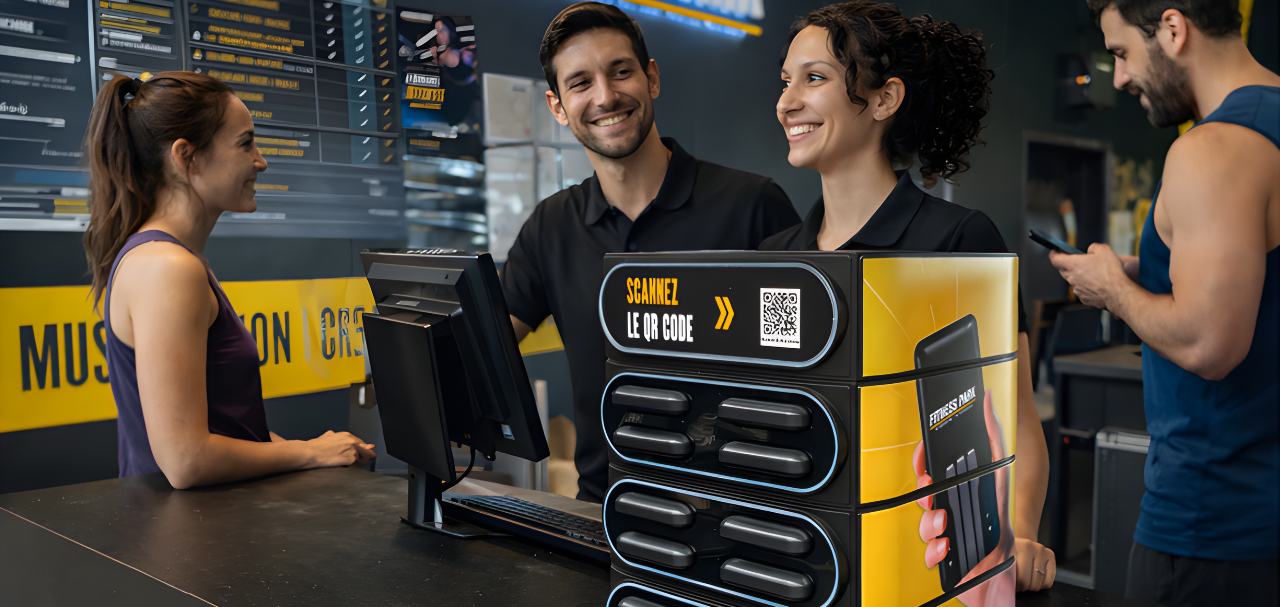
Plug'Heur supports fitness centers with self-service portable battery charging stations.
An additional service with no extra management required that improves the experience and your NPS.
www.plugheur.com
Capture their data!
Capture them hot!