
.svg)

3
Min reading
Increase time spent at your booth: 7 concrete levers to retain, engage, and convert at trade shows
Posted on
July 22, 2026


At a trade show, everything happens in a matter of seconds. Visitors scan, compare, and keep moving. Your challenge isn't just to grab attention, but to create the conditions for a smoother, more useful, and more memorable interaction.
In this environment, the most successful booths aren't necessarily the ones that do the most.
They are often the ones that make the experience simpler, more comfortable, and more intuitive for the visitor.
In other words, increasing the time spent at a booth doesn't rely solely on entertainment or your sales pitch.
It also comes down to very concrete elements: useful service, a clear promise, natural interaction, or visible proof that provides immediate reassurance.
Here are 7 dimensions that directly influence the quality of engagement at a booth, with concrete examples observed in the field.
1) Useful service: giving them a good reason to stop
At a trade show, visitors are constantly being solicited.
When a booth provides a simple answer to an immediate need, the conversation becomes more natural.
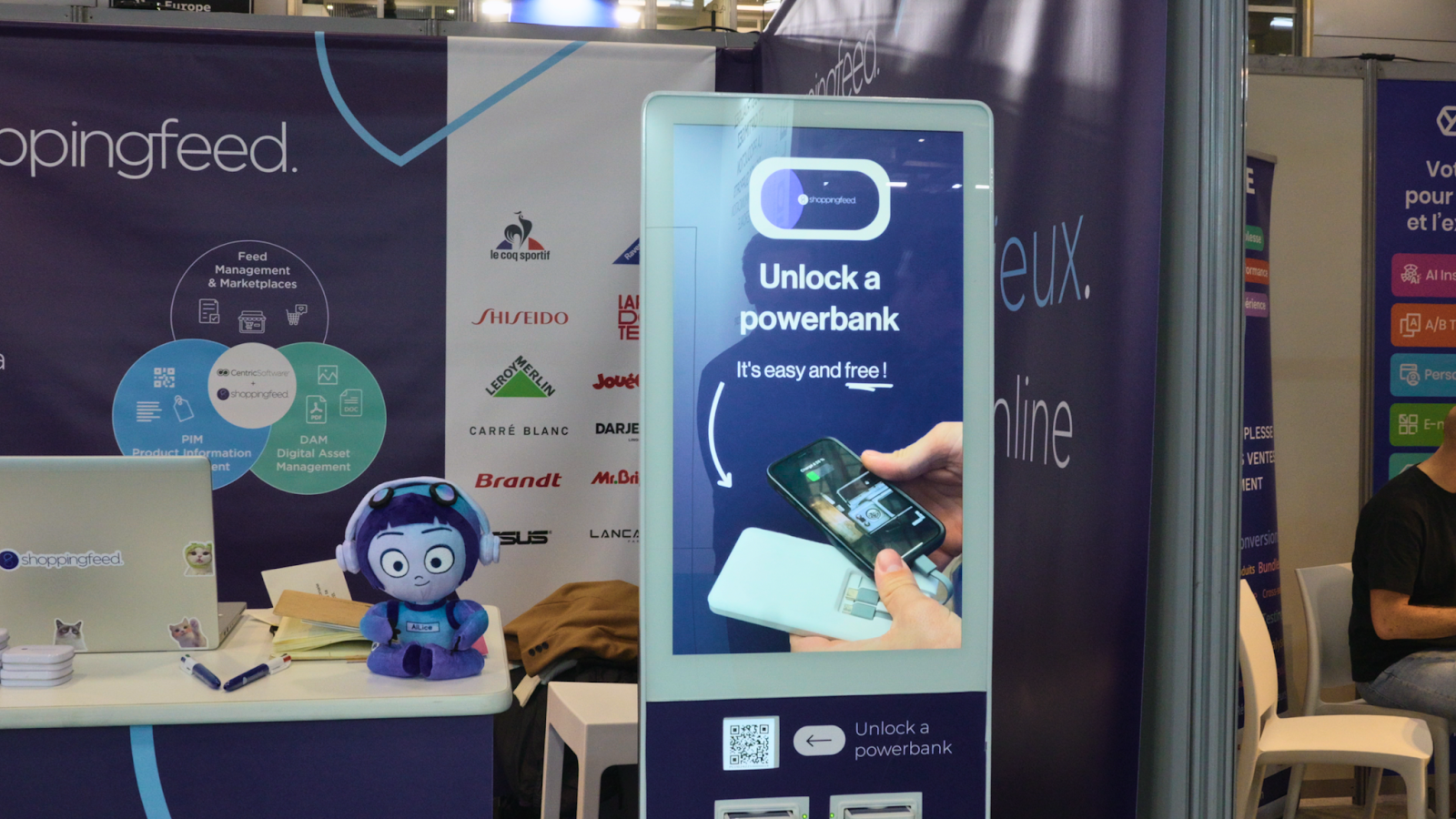
Phone charging stations, water stations, lounge areas, mini-services, or practical information: these gestures all have one thing in common.
They make the booth more welcoming, more useful, and often easier to approach.
With this in mind, features like phone charging stations address a universal need while improving the on-site experience.
2) The comfort lever: retention is often a matter of tired legs
Comfort is underestimated. Yet, most booths lose visitors not due to a lack of interest, but because of fatigue, heat, noise, overcrowding, or a lack of clear direction.
To improve comfort at your booth, focus on micro-improvements with a direct impact:
- 2 to 4 visible seats, even high ones: being able to sit down extends the visit
- a breathing space: softer lighting, less noise, clear circulation
- a drop-off point for bags or coats if your target is B2B and on the move
- signage readable from 5 meters away: less cognitive effort, more availability to engage
Comfort is not a luxury. It is a performance tool. A comfortable visitor listens better, asks more questions, and is more willing to accept a demonstration.
Checklist : does your booth have a place to stand without blocking the flow?
3) Guided interaction lever: create a sequence of micro-actions
Many booths demand a high level of commitment right at the entrance, such as booking an appointment or watching a full demo. This is often too soon.
To increase interactions, structure a journey based on micro-actions:
- choose a profile, with a maximum of 2 to 3 options
- answer a quick question
- test a feature in 30 seconds
- get a recommendation or a score
- leave with a useful resource
The idea: each micro-action triggers a small "yes" that paves the way for the next one. This increases time spent and improves the quality of the sales conversation.
Simple example:
- Are you more of an X, Y, or Z?
- Got it, in that case, here is the most relevant demo for you.
- Shall I also email you a summary?
Checkpoint : is there an action for the user to take, rather than just something to look at, within the first 15 seconds?
4) The proof lever: the more a visitor believes, the longer they stay
People stay when they feel there is something solid. Proof doesn't have to be a complex study. It can be simple, visual, and immediate.
Types of proof that enhance the visitor experience:
- live demonstrations, even if short and repeated
- key figures displayed, without overpromising and sourced whenever possible
- use cases told in 30 seconds, focused on results
- before-and-afters, comparisons, or real samples
- social proof: queues, testimonials, logos, only if authorized
Tip: display one main piece of proof, not ten. Too many claims create doubt, which leads to visitors leaving.
Checkpoint : is your number one piece of proof clearly visible?
5) The rhythmic engagement lever: set a tempo to prevent drop-off
A static booth empties out. A rhythmic booth keeps people engaged.
Create a visible tempo:
- a mini-demo every 10 minutes
- a scheduled event: quiz, reveal, or giveaway
- a very short but regular activity, 2 minutes maximum
Rhythm creates:
- a reason to stay, because it’s starting
- a reason to come back, because it’s starting again at a specific time
- a social density that draws people in
Important: your engagement strategy must serve your business goals. The goal isn't just to make noise, but to drive qualified traffic.
Checklist : can people understand at a glance what is happening here, right now?
6) Team and script leverage: the quality of the welcome determines the length of the interaction
Two identical booths can produce two opposite results. The difference often comes down to the team.
To retain and convert, assign specific roles:
- a greeter role, to guide and filter
- an expert role, for demos and technical questions
- a conversion role, for scanning, opt-ins, and booking appointments
And above all, use simple scripts:
- a non-aggressive opening line, focused on needs
- a maximum of two qualifying questions
- a clear transition to the demo
- a call to action: resource, appointment, or trial
Example framework:
- Are you looking to improve X or Y at this show?
- Sure, let me show you the most relevant version in 45 seconds.
- If you'd like, I can send you a recap and we can schedule a time to talk.
This lever directly impacts conversion: a better-structured conversation lasts longer and is more likely to succeed.
Checkpoint : do your teams know exactly what to do during peak hours?
7) Capture and follow-up lever: turning time spent into value after the event
Increasing time spent is only useful if you capitalize on it. Otherwise, you're just generating nice traffic that drops to zero the next day.
The right approach is to link booth retention to a logical next step:
- sending a personalized resource
- proposing a meeting
- triggering a trial
- signing them up for a longer demo
- activating a trade show offer
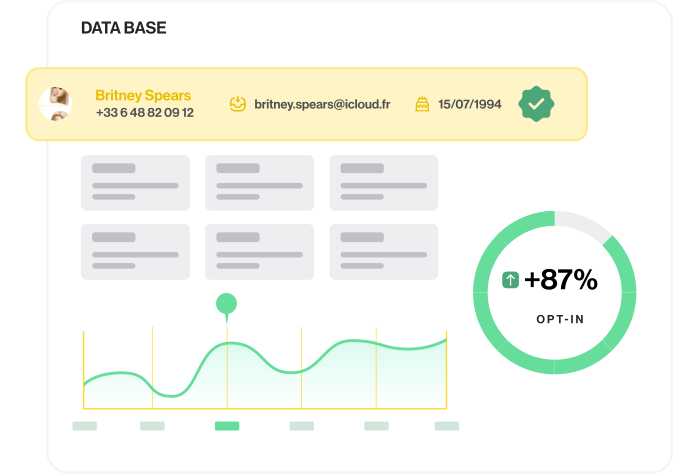
If you are collecting emails or phone numbers, do it properly:
- explicit opt-in, with an unchecked box and clear wording
- stated purpose, for example, receiving the recap and our resources
- proof of consent stored
- easy unsubscribe option
- data minimization, only ask for the essentials
In practical terms, a good strategy aims to:
- a longer, and therefore higher-quality, interaction
- consented data capture, and therefore actionable
- follow-ups at D+1 and D+7, and therefore convertible
Checkpoint : at the end of the interaction, does the visitor know exactly what they are receiving and what happens next?
Mini operational checklist to increase time spent at your booth
Before the trade show:
- a main value proposition visible from 5 meters away
- a useful, ideally universal, service to engage visitors
- an interaction that is simple to complete in 30 seconds
- strong, visual proof that is understandable without a pitch
- a consistent activity schedule, every 10 minutes or at set times
- defined roles and scripts for opening and qualifying conversations
- a conversion scenario: resource, meeting, trial, or GDPR-compliant opt-in
During the trade show:
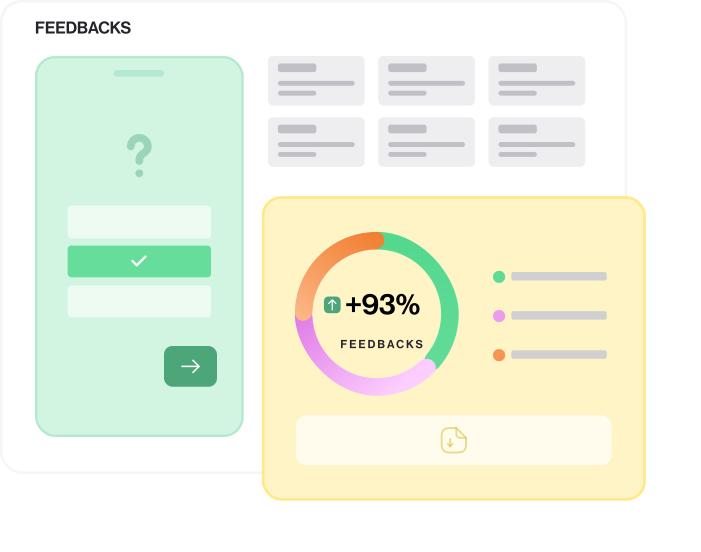
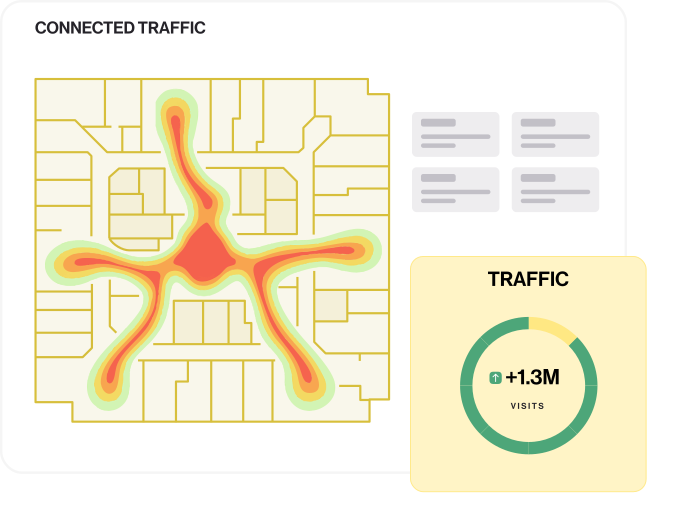
- measure: interaction volume, opt-in rates, meetings booked, recurring questions
- adjust: signage, queue management, demo length, role distribution
After the trade show:
- prompt follow-up at D+1, then nurturing at D+7 and D+21
- reporting: what engaged visitors, what converted them, and what needs to be simplified
Conclusion
Looking to improve your booth experience with a service that is useful, easy to deploy, and immediately visible?
Contact us !
Capture their data!
Capture them hot!



Benjamin
Rédacteur